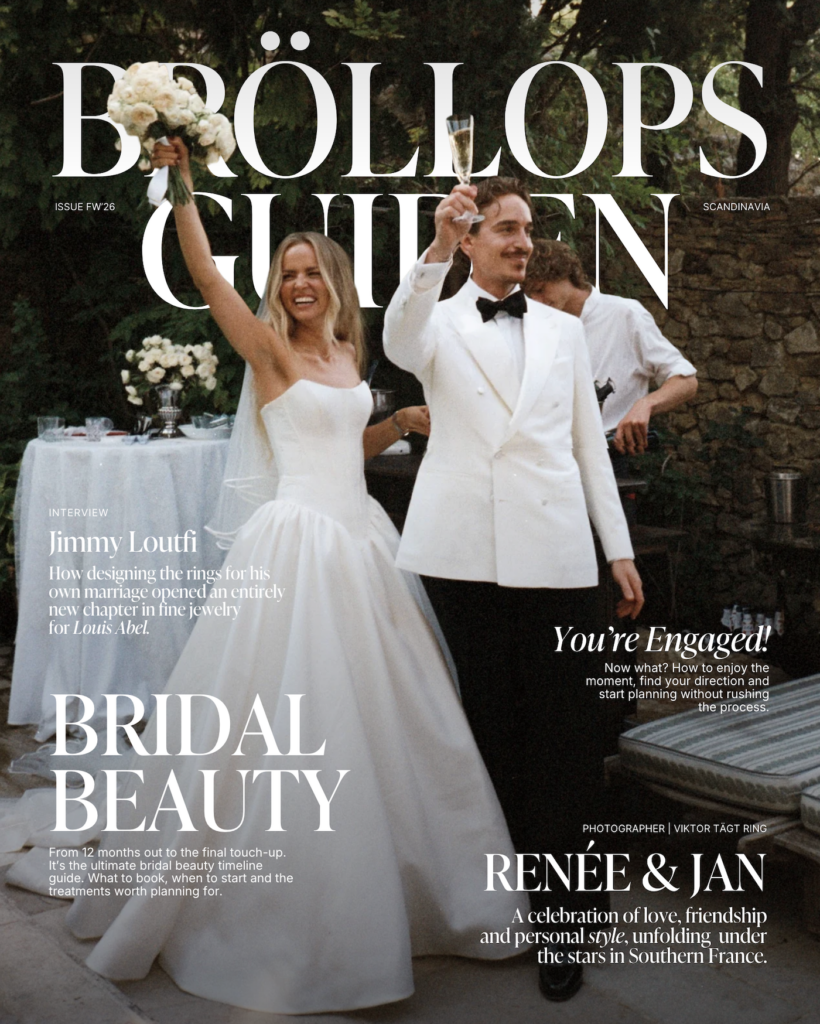
ISSUE FW’26
In our new FW’26 issue, we take you to the south of France and to Renée and Jan’s wedding, which was a celebration of love, friendship and style. We also sit down with Louis Abel founder Jimmy Loutfi for an in-depth interview about how his own wedding rings marked the start of a new chapter in fine jewellery, and look ahead to New York Bridal Fashion Week for the silhouettes, details and ideas that will set the tone for the coming season.
Guests
The Art of Public Speaking
A wedding is a day of joy, but also a day filled with nerves. Perhaps especially for those who are due to give a speech.


The art of giving a speech at a wedding
A wedding is a day of joy, but also a day filled with nerves. Perhaps especially for those who are due to give a speech. Bröllopsguiden often receives questions about speeches. How do you give a good speech? What should you bear in mind? We have asked an expert in the field, public speaker and speechwriter Bengt Ivarsson, to tell us how he goes about it.
Contents:
The speech to the bride and groom
: – Introduction
The wedding speech
: – Step 1. Mapping out and selecting content –
Step 2. Refining the
content – Step 3.
Structuring – Step 4.
Outline of the speech – Step 5. Drafting the
speech – Step 6. Memorising the speech
On 2 October 1954, the Old King inaugurated the University of Gothenburg. We students stood in the foyer of the Gothenburg Concert Hall and watched His Majesty stroll down the grand staircase. He was to address us. The microphone stood on the bottom step. We saw no manuscript. When he reached the microphone, he stretched his arm backwards without looking back. There stood his aide-de-camp, Lieutenant-General Hugo Cedersköld. From the cuff of his uniform, he retrieved a manuscript and handed it to the Monarch. Without turning round, the Speaker, having completed his task, returned the manuscript to the person holding it, who tucked it back into the cuff.
Most of us do not have this service. When the time comes, we must rely on our own resources. Since, for example, at weddings most speeches are given at the end of the dinner, two groups form at the table from a dietary perspective: the upcoming speakers and the rest. Among the former group, only 30 per cent of the standard portion is consumed, even if veal cutlets and nightingale tongues are on the menu. In contrast, this group empties their glasses in one go at every ‘Cheers’. The staff soon realise what is needed and discreetly top up the drinks. Bribes are said to be common. Once the speech has been delivered, only a little strawberry sorbet remains for the hungry guest. The speaker’s lot is a difficult one.
In some parts of the world, baby girls are said not to be welcome. For a time, they were abandoned in the wilderness to die. Researchers have their theories as to the reason for this. But I believe one important reason has been overlooked. For every baby girl, the father reckoned he’d have to deliver the father’s speech to the bride at the wedding. So why endure twenty years of torment when you could get rid of the problem right from the start? One of my good friends, a middle-aged partner in a coffee shop, had six daughters in a row. He solved the problem by mixing half schnapps into every drink and thus gave the same speech at six weddings in a row. Afterwards, they were served coffee. No one had ever heard the speech.
The wedding speech
So what do you do if the time comes? A speech to the bride and groom is not really any different from other speeches in private settings. All such speeches can be prepared and delivered following roughly the same pattern.
Firstly, I’d like to clarify the purpose of the speech. In my view, it should be part of the entertainment at the party. It should be light-hearted and, if possible, amusing. Everything during the party should contribute to the entertainment. Speeches in which one lists the honourees’ contributions and merits, what they have done for the benefit and welfare of society, their careers and other matters as set out in their application documents, do not, in my view, belong at the wedding table. Such speeches are more appropriate when the groom is being thanked by the chair of the local council after 30 years of service as a deputy member of the temperance board.
Step 1. Assessing the audience and selecting content
1. Assess your audience. You cannot use quotations in French or Latin if your audience is not familiar with these languages. When I write speeches for an audience I am unfamiliar with, I use a questionnaire. That way, I know the parameters. I know what I can joke about, what is inappropriate, and whether I dare to use the word ‘moonshine still’.
2. Select the aspects of the bride and groom’s lives that you wish to include in the speech.
The speech should not provide a comprehensive overview of the couple.
– Choose episodes from their lives that you can turn into something amusing. – Don’t choose events that are only funny to you and the bride and groom. The speech should be entertaining, so that everyone can join in and have a laugh. – Avoid
anything that might be embarrassing for anyone in the audience. An account of the stag do featuring a drunken groom is embarrassing for everyone and reflects badly
on you. Don’t rush the selection process. It should take a week or two. You’re most likely to have your best ideas whilst waiting at a red light or in the queue at the off-licence.
Step 2. Editing the content
The Danish poet Igor Rasmussen lived off his poetry. He lived on the top floor. His wife lived on the floor below. Every morning at six o’clock, she would tap the ceiling with a broomstick and shout: ‘Get up and write, Igor.
But inspiration doesn’t necessarily strike when we want it to. Yet the marvellous can happen. Once I have the content in my head, the entire structure of the speech can come to me all at once. This has happened remarkably often whilst I’m running on the floodlit track or mowing the lawn. I’m sure everyone has noticed that you can drive mile after mile without really taking in the road. Your mind is somewhere else. Those can be the creative periods. That’s when it can happen. But creativity comes at a price. Once I was on my way to Ullatti but missed the turn-off and ended up in Skruv!
Step 3. Structuring the speech
This is the trickiest part, but it can be the most fun.
A particularly important part of this section is storytelling (or ‘lying’). When I was little, we weren’t allowed to lie. But here in Värmland, where I live, storytelling is considered one of the fine arts. You’re allowed to make things up. But everyone must realise that you’re making things up. There’s no point to the storytelling. You don’t laugh when the storytelling is over. It is the story itself that is meant to be entertaining. Great masters of this art include Frans G Bengtsson and Fritiof Nilsson Piraten, or, more recently, Hasse Alfredsson.
When it comes to a wedding speech, one can therefore try to weave a humorous tale around the episode one has chosen. You can either weave a tale around several episodes or select just one and let it form the basis of the entire speech. But I repeat: the speech should be entertaining and not provide a comprehensive overview of someone’s life and experiences.
Scenario:
As a relative, I am to give a speech at Ann Britt’s and Bosse’s wedding and have chosen to elaborate on a few episodes. I have chosen: – How
Ann Britt found her fiancé, and – Ann
Britt’s degree project, which took place at a social services office in New Zealand.
This section makes up about a quarter of the entire speech. They got married in Döderhult Church, not far from the nuclear power station in Oskarshamn, where Bosse had found a job. Through my fictionalisation, I wanted to poke a bit of fun at the fear of nuclear power and make it seem as though the parents were determined to prevent the marriage at all costs. I have selected the following example to illustrate how such fictionalisation can be achieved:
The distance between Döderhult Church and the nuclear power station in Oskarshamn is 42 kilometres. There are always risks involved in getting married. In the past, the risk for young people thinking of getting married was premature cell division. Now there is the added risk of atomic fission.
Ann Britt comes from a very solid family. Everyone in her immediate circle voted ‘NO’ in the nuclear power referendum: her parents, her maternal grandfather, her maternal grandmother, her paternal grandfather, her paternal grandmother and her nursery teacher. From childhood, Ann Britt has learnt not to jeopardise our environment. At her childhood summer cottage, they used kerosene lamps and a compost heap. When television came into fashion, they bought a second-hand black-and-white TV with Channel 1. Her father, Rune, had organised an exercise bike with a generator. Twice a week, he would pedal his way through half a series of *Dallas*, and sometimes, as a surprise for the children, a couple of minutes of *Polman*. Ann Britt lived a world away from fuel rods and becquerels.
When the time came to find a fiancé, she was keen to choose someone in the family spirit. Preferably someone who could pedal their way through the whole of *Dallas*. She’d never actually seen the ending, after all, and was curious to find out what happened to J.R. She got hold of catalogues for the universities in Gothenburg and tried to work out which course of study would suit her, given the specific requirements she’d set. A friend had chosen a dark-haired lad with good exam results from the Academy of Music. The relationship was happy until it turned out that his main instrument was the bass tuba. Their happiness came to an end in a one-room flat in Haga. She threw out the bass tuba, and with it went the lad.
No, Ann Britt was smarter. She went straight to the Chalmers catalogue and ruled out the Department of Chemical Engineering. After all, they used to release chlorine and were often seen having heated arguments with Greenpeace on the telly. She ruled out Chemistry. Theoretical physics seemed harmless. Just formulae on a piece of paper and clean clothes. But she also wanted him to be of some practical use. So that had to do. She chose the Department of Civil Engineering. Her dad, Rune, was going to improve the road up to the summer cottage and also drill for water on the plot, so she reckoned this choice would work out well. She really wanted a popular fiancé who could also be of practical use.
……………
(Ann Britt now happens to choose a Chalmers graduate, who, the day after graduating, gets a job at the nuclear power station in Oskarshamn. The family finds out about this. How they react in the following episode is my own invention. It is true, however, that Ann Britt went to New Zealand).
……………
Three days after graduation, Bosse was recruited by the Oskarshamn nuclear power station. Her father, Rune, reacted quickly. He rang me and asked for advice. I said that, when girls here in Värmland find themselves in trouble, we usually send them to Uzbekistan. There they get to milk camels for a year or so and have time to forget the lad. Rune thought the advice was sound but felt that Uzbekistan was a bit too close to Mölndal, where Ann Britt lived. It would ideally be a deserted island as far away as possible. He chose New Zealand, the South Island. There was a reassuringly large amount of water between the South Island and Mölndal, and besides, the island had a dreadful lot of sheep. A shepherd with 5,000 sheep would make a fine son-in-law.
Ann Britt was sent off as if nothing had happened. After a week, she was settled in as a sheep shearer at Saskethuan Cheep and Farm Corporation Limited in Rocky Mountin. There was no telephone, and the nearest town was 14 mil away. There were no buses.
After a week, Bosse had realised what the situation was. No one had reckoned on him having saved up his student grant. The money was just enough for a plane ticket to New Zealand. But there were only airfields on the North Island, and the money wouldn’t stretch any further. Dad, Rune, had got his sums right. The water would save his daughter. Rune and I discussed it. I have the 27th edition of the Nordic School Atlas, and I could see from it that there’s a narrow strip of blue between the North and South Islands. Bosse would probably not venture out onto the water, especially as the Pacific Ocean was starting to freeze over at this time of year. They’d probably just stand there shouting to each other across the water on Saturday evenings, and Dad Rune would have to put up with that, so to speak…
But everyone knows how it turned out. After all, water was part of Bosse’s training. One course dealt with King Charles X Gustav’s crossing of the Great Belt. It’s not often that you get to put what you learn at university into practice. But King Charles X Gustav’s crossing proved to be an exception. Once the Pacific Ocean had frozen over, Bosse marched across and, with the authority of a victorious commander, was able to dictate the terms.
……………
Step 4. Outline of the speech
The speech should comprise the following sections:
– An unusual and intriguing opening (introduction)
– An entertaining main body
– A warm and heartfelt conclusion.
The first few sentences of a speech are incredibly important. They should surprise the audience or perhaps make them wonder what is meant. They should arouse the audience’s curiosity. The wedding speech quoted above begins with: ‘The distance between Döderhult Church and the nuclear power station in Oskarshamn is 42 kilometres.’ This is an example of what I mean by an unusual and surprising opening. No ‘Honoured Bride and Groom’ or other conventional phrases.
The
latter part of the speech should be personal in nature. The speech should conclude with a wish for the couple’s future happiness and a heartfelt expression of warmth towards them. This can be tailored to suit each speaker’s own taste. It all depends on the speaker’s relationship with the bride and groom and the tone that is customary for this occasion. What suits one speaker may feel out of place for another.
However, I would like to warn against one thing. It is risky to put too much emotion into the closing section. There are two reasons for this:
1. The speaker may become overwhelmed by emotion and find it difficult to do the speech justice.
2. A feeling should ideally be shared by everyone – or almost everyone. If the bride and groom or the audience are not on the same wavelength as the speaker, the speaker’s emotion may be perceived as embarrassing by the audience. There are words which are warm but do not need to provoke uncontrolled or unexpected emotion in the speaker.
But I’d like to give some examples of how the conclusion itself might be structured. Personally, this one suits me:
Julia is an ideal daughter. Of my two daughters, only Cleopatra can give her a run for her money. With Julia, you’re never bored, either as a parent or – I believe – as a friend. She’s eloquent. She has analytical acumen and is full of ideas. Julia is as clever as a poodle, and she has one important quality: she cares. When the phone rings at half past eleven at night, we know it’s Julia. She’s there when needed. She’s a great joy.
And then there’s Romeo. He’s a real find, both for my family and for Julia. He’s sharp-witted and humorous, and he’s also articulate – a quality that’s essential for holding his own in Julia’s company. He fits into our family incredibly well, and we have a lot of fun together.
I believe you have the best possible foundations for a happy life together. You are both active and have a zest for life, and you support one another whether it’s the hunting licence exam or the Rösjö Race. You have also learnt to communicate as equals. Neither of you is dependent on the other. You stand on equal footing.
Today is a happy day for both of you and for us. Happy memories can serve as a fence against the wolves. We will look back on this day often. Not just when the wolves howl.
Step 5. Drafting the speech
It’s pointless to sit around waiting for inspiration to write the speech. You just have to get started. You’ll often find, to your surprise, that it comes easily once you’ve started. Many writers have said that you can sit in front of the computer for days on end without coming up with anything to write. That sounds dreary. But at the same time, they say that suddenly the words can just flow. And that’s been my experience too. When I was writing this article, for example, I only had a rough idea of what it would cover. But as I wrote, the words just flowed and I wrote more or less without stopping. So start writing without waiting for some divine spark. It can work either way.
Write without worrying about phrasing! Let the speech settle for a while, then go back and make changes and corrections. It can be an enjoyable task. For many people, finding amusing and witty turns of phrase is a pleasure.
Step 6. Memorising the speech
There’s no shame in reading from a script. There are memory experts who learn entire speeches by heart. But don’t expect this to be an easy task. Anyone who tries will be nervous for weeks beforehand. What might happen? You probably already know: you might lose your train of thought, you might forget long and important sections of the speech, you might get so nervous that your voice trembles, and much more besides. How Bill Clinton managed to deliver a twenty-minute presidential inauguration speech without a script is a mystery.
No, learn to read the speech without being too tied to the script. If the content of the speech is good, no one will even notice that you’re holding a script. However, there are two parts you must learn by heart: the first two or three sentences and the final warm words to the bride and groom. With the script in your inside pocket, you can enjoy the dinner without feeling nervous. After all, you know you can read it. It’s hard to imagine that you could make a fool of yourself. Everything is sorted, after all.
One problem, which I won’t go into here, is that you might be overcome with emotion when speaking to your daughter, who is now leaving home. How to cope with this is another matter entirely.
Other wedding speeches
At weddings, there are, of course, other speeches besides the father’s main speech to the bride and groom.
In fact, they do not differ in structure and form from the Speech to the Bride and Groom. Here, too, the entertainment aspect is the decisive factor. As they are usually shorter than the main speech, it is an advantage if the speaker in this case knows the bulk of the speech off by heart. However, he should have the manuscript to hand in case of any memory lapses.
Miscellaneous
Giving a speech is fun, provided you have a good script. The problem is getting hold of one. To have a coat altered into a suit, you go to a tailor; to have a pig slaughtered, you go to a butcher; to get a script, you go to a speechwriter.
Bengt Ivarsson
Related articles
-
 Guests
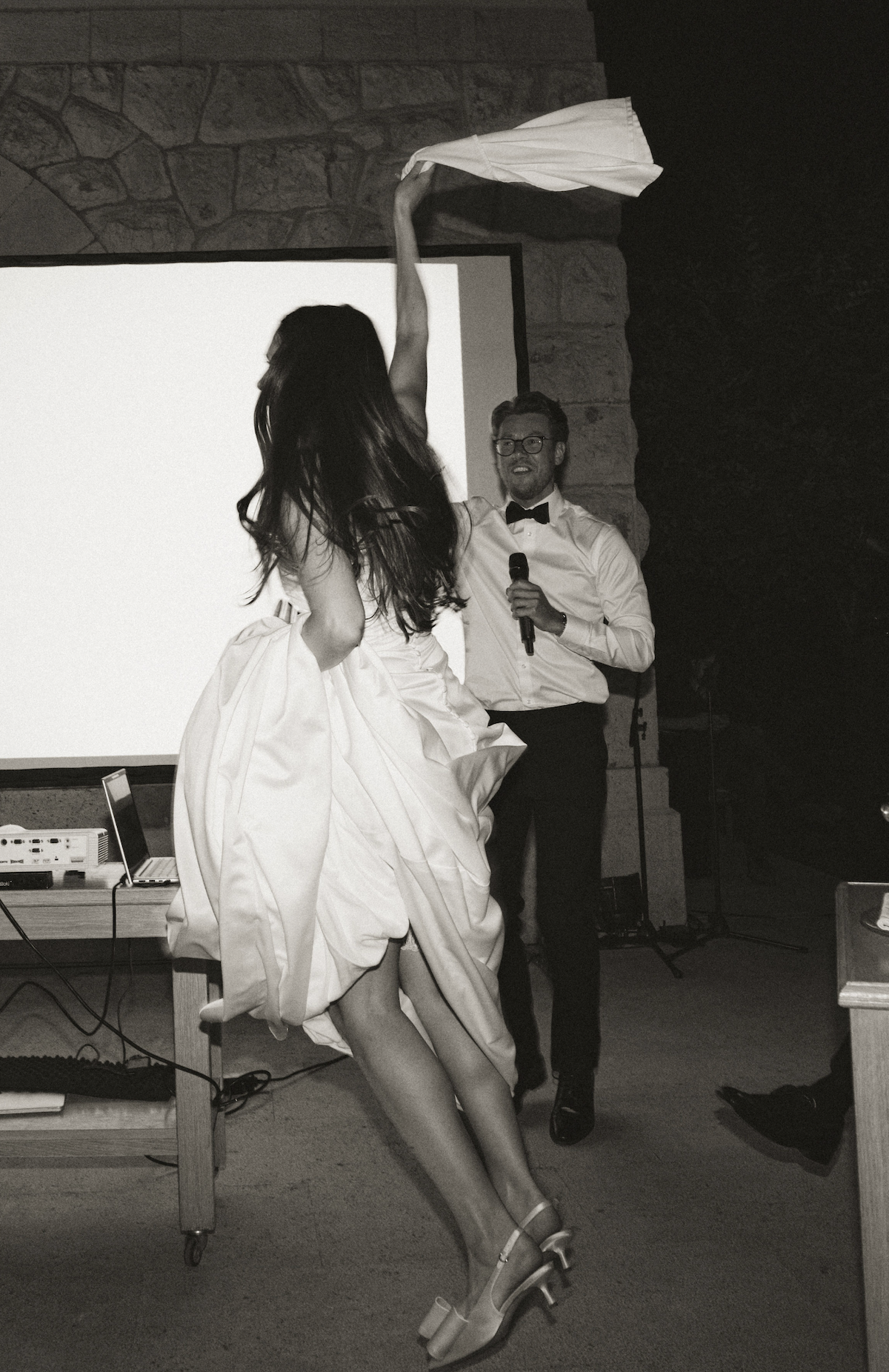
Toastmaster’s Guide: Fun party games and skits for weddings
As the toastmaster, you’re responsible for setting the mood at the reception! Here you’ll find fun games and skits that will make the wedding reception…
-
 Guests
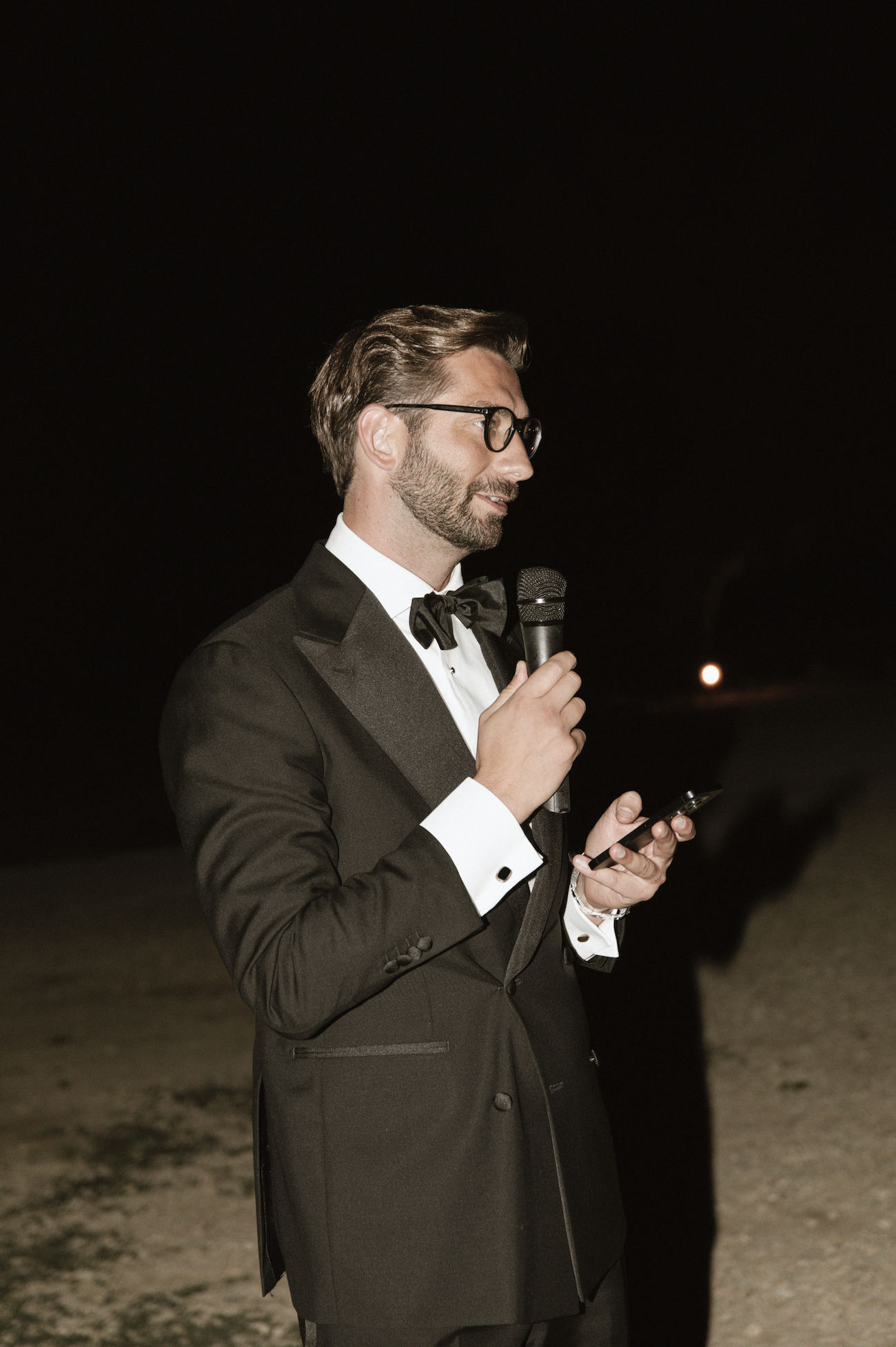
You’ll definitely be able to sort out that wedding speech – A comprehensive guide with tips and advice
Giving a speech at a wedding doesn’t have to be difficult – here’s how to do it with tips from speechwriter Magnus Alm.
-
 Guests
How to create the ultimate wedding guest list
According to many, drawing up a guest list for your wedding is one of the most difficult tasks in wedding planning. We’ve put together some…
-
 Guests
Your best friend’s wedding
Your best friend is getting married and you want to do everything you can to make the day unforgettable. Here you’ll find inspiration and tips…
-
 Guests
37 Inspiring Wedding Wishes for Telegram and Postogram
Wedding telegrams and postcards. 37 telegrams for the wedding. Messages for telegrams and postcards for the bride and groom. You can also include these messages…